
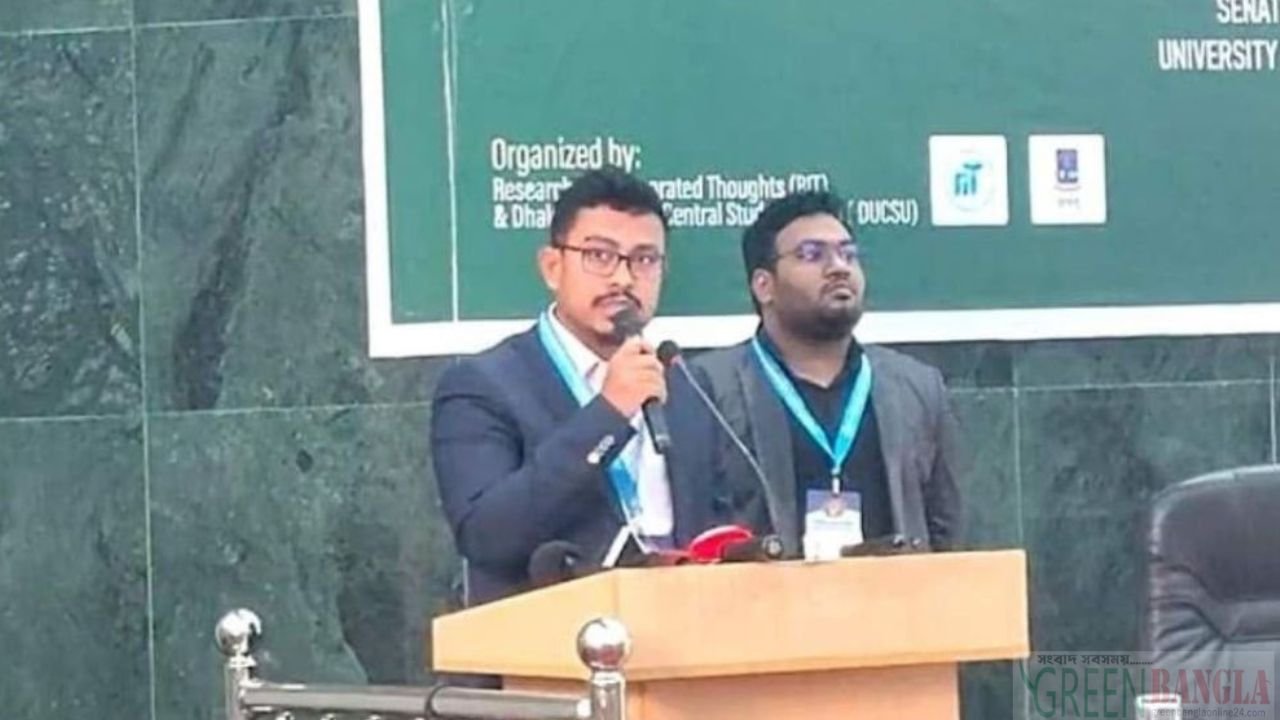
Attempts are being made to make July heroes villains: Sadiq Kayem
Dhaka University Central Students’ Union (DUCSU) Vice President (VP) Sadiq Kayem said that after the fall of the authoritarian regime, many leaders fled the country with hundreds of millions of dollars stolen from Bangladesh. Today, they are using that stolen money to tarnish the July Revolution from abroad. They are trying to present the July heroes as villains.
He said these things while speaking as a special guest at the ‘International Conference on the 2nd July Revolution (ICJR-2 2026)’ held at the Nabab Ali Chowdhury Senate Building of Dhaka University today (July 19). Sadiq Kayem said that for the last 15 years, an authoritarian regime has stifled our voices and deprived us of the right to choose our own future. We have gone through very difficult times. For the last 16 years, this country has been plagued by disappearances, human rights violations, extrajudicial killings and countless inhumane acts. The July Revolution was born from that injustice.
He also said that they think that their campaign will make us forget everything. They think that people will forget that they have killed hundreds of people, disappeared, looted the country’s resources and committed crimes against humanity in the last 15 years. But we will never forget it.
The DUCSU vice-president said that this July movement became a united struggle against oppression, tyranny and dictatorship. In 1971, we fought for free, fair and acceptable rights. And finally, in this July month, when our rights were attacked, Bangladesh rose again. In that sense, the July Revolution is a part of our long and glorious national heritage.
He said that people from all walks of life joined this movement and it was an inclusive struggle of people from all walks of life. Students stood by teachers; rickshaw pullers, businessmen, daily wage earners, workers, farmers, artists, political activists and ordinary citizens united. Everyone had one goal: to restore their rights and ensure justice.
Sadiq Kayem said, by the infinite mercy of Almighty Allah, the people of Bangladesh have defeated the dictator. We have regained our rights, regained our voice and ended the fascist regime. And that is why for every freedom-loving citizen of Bangladesh, this was not a revolution of any party, any organization or any individual; it was a revolution of the people, it was a revolution of all walks of life.
Stating that everything is not fulfilled overnight after a revolution, the DUCSU Vice President said, Bangladesh did not become a paradise of justice overnight. So it is natural to have some disappointment. I agree with many of your concerns, but that does not diminish the glory of the July Revolution. July was not just a 36-day movement. Those 36 days were just the beginning of a long journey. This journey of justice, reform and healing our wounds as a nation is long. So we should not lose hope.
He said, “My message to all those who dream of a democratic and inclusive Bangladesh is very clear: July belongs to all of us. It was our revolution, it was our movement, it was the united struggle of the people of Bangladesh. Now is not the time to stand against each other. Now is the time to defend our achievements and build a better future.”
He added, “The fallen dictatorial regime and its minions are trying to return to our political life, but we will not let them take away what our people have achieved with courage, sacrifice and blood. That spirit of July still calls us today. It calls us to unite, to defend democracy, to ensure justice. It calls us to ensure that Bangladesh never falls under a dictatorial regime again.” Calling for respect for the sacrifice of July not only in words but also in deeds, the Vice President of Dhaka University Central Students’ Union said, “Let us remain united and build the free, democratic and just Bangladesh for which the people of our country have sacrificed so much.” The conference was organized by Dhaka University Central Students’ Union (DUCSU), Research and Integrated Thoughts (RIT), University of Regina (Canada), Nanyang Technological University (Singapore) and Youth for Better Future Society (YBF).