Teachers and students struggle to rebuild Islamic University of Gaza from rubble
The education system in Gaza has been in a dire crisis due to Israel’s long military campaign. University buildings, laboratories, and key infrastructure have been destroyed. Nevertheless, the Islamic University of Gaza is trying to continue its education programs from the rubble.
Before the war, the Islamic University of Gaza was one of the most important higher education institutions in the Palestinian territories. The institution had modern laboratories and research facilities, with a special emphasis on practical training-oriented subjects such as medicine, health sciences, and engineering.
Students regularly spent time in the laboratories. They prepared for future professional skills by using medical equipment, testing samples, and applying theories learned in the classroom to practice.
But everything changed with the Israeli military campaign that began on October 7, 2023. A large part of the university’s campus, laboratories, and training infrastructure were destroyed in a series of attacks. At the same time, the tight blockade on Gaza made it difficult to bring in and out educational materials.
Yassin, the university’s laboratory coordinator, said that just a few days before the war began, new anatomy models and training equipment for the Department of Medicine and Health Sciences arrived at the university. The plan was to familiarize students with the real working environment through these equipment. But after the war broke out, it was not possible to take this initiative forward.
University in ruins –
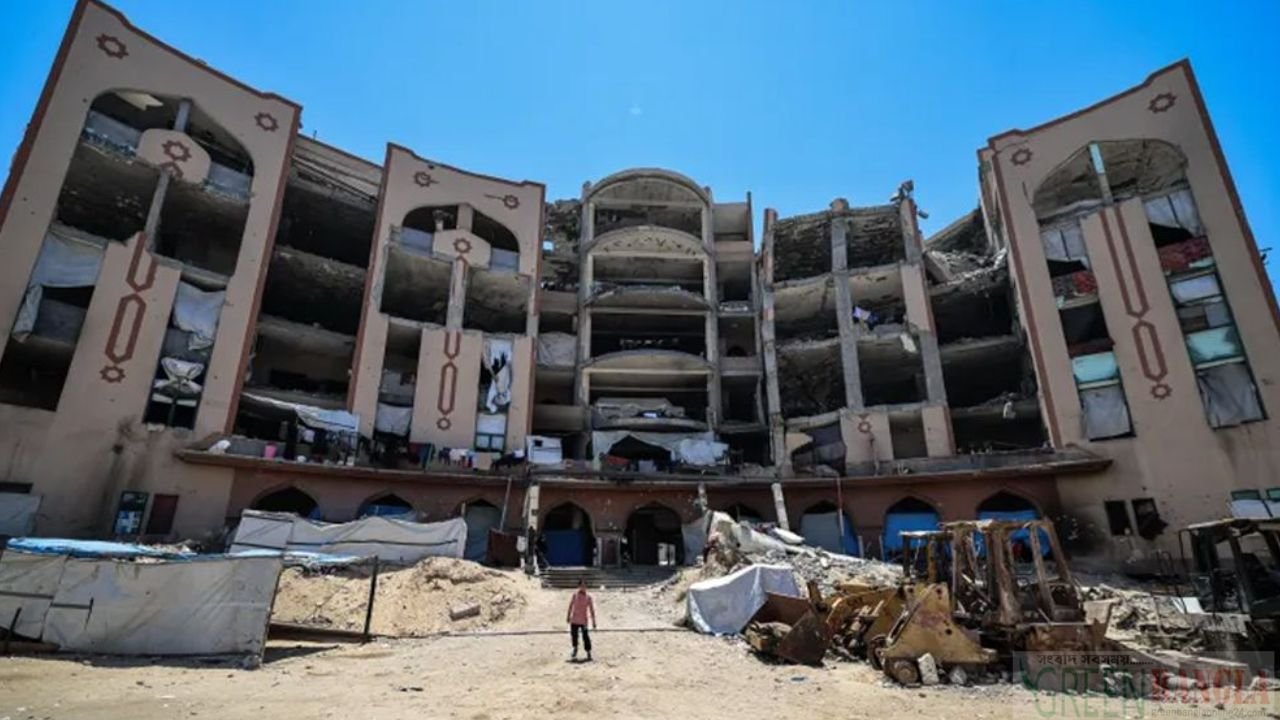
The Israeli attack destroyed 19 academic buildings at the Islamic University. About 500 classrooms, 200 scientific laboratories and 75 computer labs were damaged. The university’s central library lost more than 240,000 books, research journals, reference materials and academic theses.
Abdul Rauf Al-Manama, Dean of the Faculty of Health Sciences, said that the past three years were one of the most terrible periods in the university’s history. According to him, the attack destroyed not only buildings, but also research equipment, training clinics, scientific instruments and a large part of the knowledge base built over five decades.
What stands there now is essentially the ruins of a destroyed university, he said. Many university buildings have been turned into shelters due to mass displacement during the war. The lack of classrooms, power and internet outages, and the mental stress of students and teachers have made educational activities even more difficult.
Videos instead of labs, hospitals instead of classrooms – A joint assessment by the Palestinian Ministry of Education and UNESCO found that most higher education institutions in Gaza have suffered major damage since 2023. Many specialized laboratories are no longer usable. As a result, subjects that require practical training are now often limited to theoretical lessons.
To address this crisis, the university is using virtual simulations, video-based tests, and recorded lab sessions. These alternative methods are also being used in subjects such as medical sciences, biochemistry, hematology, molecular diagnostics, medical photometry, and physiotherapy. However, according to Al-Manama, these measures are only temporary solutions. Without real laboratory experience, it is not possible to build students’ skills and confidence.
Medical students’ new classroom—the hospital:
For medical student Dima Muhaisen, her entire education has changed. Before the war, she regularly received practical training in laboratories. But after the destruction of the medical faculty in December 2023, a large part of her studies have shifted to hospital-based real-world experiences.
She says that she often had to take classes standing in hospital corridors or next to patients’ rooms. “In many cases, we would take classes in a corner of the hospital or in the middle of the patient’s room, surrounded by doctors. There were not even the minimum facilities for a learning environment,” Dima says.
According to her, the most important part of medical education is the experience of working directly with patients under the supervision of a teacher. That opportunity has been severely reduced due to the war.
However, she did not stop there. She has worked as a volunteer in the emergency departments, surgical units, and wound care departments of various hospitals in northern and southern Gaza. Gradually, she was given the opportunity to take on greater responsibilities in the medical field. Efforts to continue education in the new reality
Yassin said that the biggest challenge currently is the gap between students’ theoretical knowledge and practical experience. He said that in the past, students used to learn to operate equipment directly. Now that that opportunity is no longer there, many are worried about the future.
To bridge this gap, the university authorities are coordinating with hospitals, health centers and local institutions to provide practical training for students.
In addition, five alternative education centers have been opened in different areas of Gaza to reduce the risk of students traveling. Efforts are being made to continue the education program through online classes, virtual simulations, recorded practical lessons and hospital-based training.
The main obstacle to reconstruction –
The university authorities say that rebuilding the building alone will not solve the crisis. New laboratories, modern medical equipment, microscopes, incubators, sterilization machines, specialized computers, chemical materials and laboratory supplies are needed. But the ongoing blockade on Gaza has made it a major challenge to bring these equipment and construction materials.
However, the Islamic University of Gaza has not lost hope. The authorities believe that those who continue to study today despite the rubble will become one of the driving forces of Gaza’s reconstruction in the future. “Investing in education today means investing in the reconstruction of tomorrow. Because it is equally important to rebuild not only buildings, but also people,” said student Dima Muhaisen.