
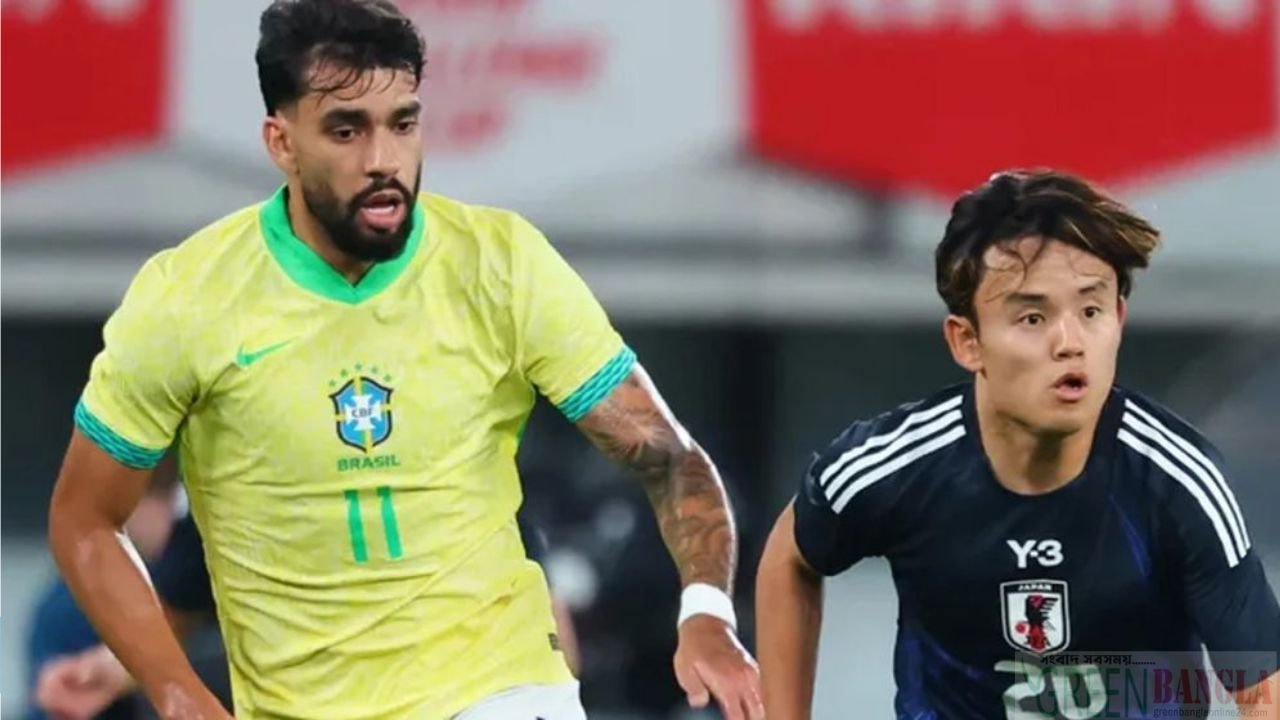
Brazil’s probable XI against Japan
Today, five-time world champions Brazil will face Asia’s strongest team Japan in the knockout stage of the World Cup. The game will start at 11 pm Bangladesh time in Houston, USA. Any mistake in the knockout stage will lead to an exit from the World Cup. So Brazil coach Carlo Ancelotti is going to take the field with the best possible XI.
As always, Alisson Becker will be in charge under the goalpost. This Liverpool goalkeeper, who has conceded only one goal in the entire group stage, is in great form. He saved the team by making several important saves against Scotland. Captain Marquinhos and Gabriel Magalhaes will be in the midfield. Danilo and Douglas Santos can be seen at the two fullbacks.
Casemiro and Bruno Guimaraes will be responsible for stopping Japan’s fast counterattacks in the midfield. Lucas Paqueta could also be seen in the starting XI to bring additional creativity to the attack with this pair, who have been in rhythm for two matches.
With Rafinha absent due to injury, 19-year-old young winger Ryan could get a place in the XI. He played well as a substitute in the previous match. The main hope of the attack is undoubtedly Vinicius Junior. The forward, who has scored four goals and an assist so far in this World Cup, could be paired with Matheus Cunha, who has scored three goals.
However, the most interest of Brazilian fans is around Neymar Jr. He played the last 20 minutes of the previous match after recovering from a long-term injury. It is unlikely that he will be put on the field from the start this time too. Ancelotti may use Neymar in the second half, understanding the situation of the match. At the same time, young Andric may also get a chance as a substitute. Brazil’s probable starting XI: Alisson Becker, Danilo, Marquinhos, Gabriel Magalhães, Douglas Santos, Casemiro, Bruno Guimarães, Lucas Paqueta, Ryan, Matheus Cunha and Vinicius Jr. Japan’s probable starting XI: Gion Suzuki, Suzuki, Suzuki, Koshiuki, Suzuki, Suyuki. Ritsu Doan, Ayumu Seko, Ao Tanaka, Keito Nakamura, Daizen Maeda, Ayase Ueda and Daichi Kamada.