Bangladesh-EU diplomatic relations will be further consolidated through the signing of the PCA
The diplomatic relations between Bangladesh and the European Union (EU) have reached a new level with the signing of the Partnership Agreement (PCA). Those concerned believe that this agreement will further consolidate and multi-dimensionalize the bilateral relations. Foreign Minister Dr. Khalilur Rahman visited Brussels on Monday (April 20). He was accompanied by the Prime Minister’s Foreign Affairs Advisor Humayun Kabir.
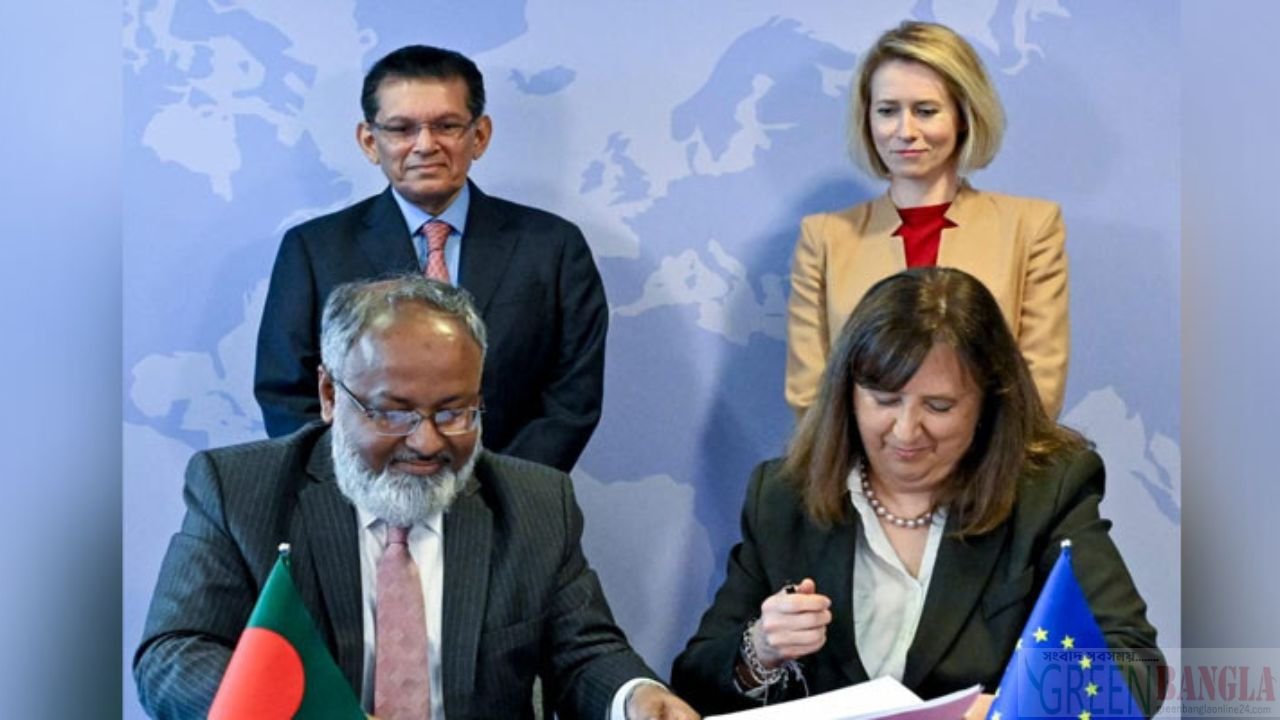
The Ministry of Foreign Affairs said yesterday that during this visit, the Bangladesh-EU Partnership Agreement (PCA) was signed at the headquarters of the European External Action Service (EEAS) in the presence of the Foreign Minister and the High Representative and Vice President of the European Union Kaya Kalas. This agreement has opened a new horizon in Bangladesh-EU diplomatic relations.
Dr. Khalilur Rahman and Kaya Kalas welcomed the signing of the PCA as a future-oriented framework for bilateral relations. They expressed hope that the agreement would further strengthen cooperation between the two sides in the political, economic, development and security sectors. They also opined that it would enhance mutual coordination in common regional and global interests.
In the subsequent bilateral meeting, both sides reaffirmed their commitment to further advance the long-standing partnership between Bangladesh and the EU. In the meeting, the Foreign Minister briefed the EU representative on the recent democratic progress in Bangladesh and the ongoing reform, reconstruction and development activities of the government led by Prime Minister Tarique Rahman.
She thanked the EU for sending a strong election observation mission to Bangladesh on the occasion of the recently held 13th national elections. In response, Kaya Kalas commended Bangladesh for organizing a successful and acceptable election.
The meeting focused on enhancing cooperation in various areas, including trade and investment, regional cooperation, migration and the Rohingya crisis. The Foreign Minister highlighted the priority issues for Bangladesh, including market access and the need to build a sustainable economic partnership with the EU. At the same time, he expressed his desire to start negotiations on a Bangladesh-EU Free Trade Agreement (FTA) and an Investment Protection Agreement (IPA) expeditiously.
The Foreign Minister expressed his gratitude for the EU’s humanitarian assistance on the Rohingya issue and sought their continued engagement in a sustainable solution to this protracted crisis. During the visit, he held a bilateral meeting with Belgian Deputy Prime Minister and Foreign Minister Maxime Privo. In addition to reviewing Bangladesh-Belgium relations, the meeting expressed optimism about strengthening trade, investment, connectivity, innovation and multilateral cooperation.
Both sides agreed to host the third Bangladesh-Belgium Bilateral Dialogue in Brussels later this year. The Foreign Minister called for increasing Bangladesh’s engagement in Belgium’s skilled sectors—logistics, port management, pharmaceuticals, technology and water management. In addition, detailed discussions were held on immigration, visa and consular issues and the Rohingya situation.
On the same day, he met with Ekaterina Zaharieva, Commissioner for Startups, Research and Innovation of the European Commission. The meeting focused on expanding Bangladesh-EU cooperation in the research, science, technology and startup sectors. The Foreign Minister called for increasing cooperation in various areas including artificial intelligence, digital innovation and sustainable development under the ‘Horizon Europe’ program.
The Foreign Minister was accompanied on this one-day visit by Foreign Ministry Secretary Dr. Md. Nazrul Islam, Bangladesh Ambassador to Geneva and Permanent Representative to the UN Nahida Sobhan, and Bangladesh Ambassador to Belgium and Head of the EU Mission Khandaker Masudul Alam.