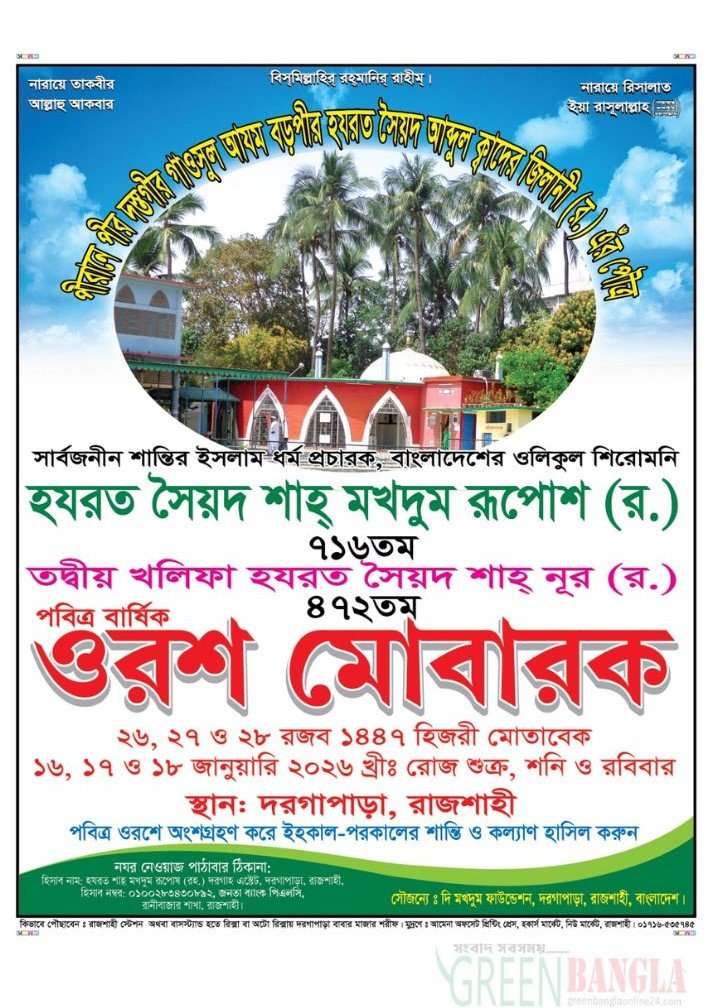
Hazrat Shah Makhdum Ruposh (R.) 716th Urs Mubarak
Writer: Sufi Dr. Md. Surayet Rahman Trustee Member, Hazrat Shah Makhdum Ruposh (R.) Dargah Waqf Estate
One of the great saints whom Allah Almighty has sent to the world for the guidance of humans and jinn is Hazrat Syed Shah Makhdum Ruposh (R.). On the instructions of Pirane Pir Dastagir Gawsul Azam Bara Pir Hazrat Syed Abdul Qadeer Jilani (R.), a group of 12 saints came to Kanchanpur (present Lakshmipur) of Noakhali district in 1285 AD from Delhi and Bihar with the aim of spreading the religion of universal peace, Islam. One of the chief of these 12 saints is Hazrat Syed Abdul Quddus alias Shah Makhdum Ruposh (RA), who is the grandson of the great Pir Hazrat Syed Abdul Qader Jilani (RA). He was born in the city of Baghdad, Iraq, on the 2nd Rajab of 615 AH, corresponding to the year 1208 AD. His father’s name was Hazrat Syed Azallah Shah alias Abdul Wahab Jilani (RA).
They established two khanqahs in Kanchanpur and Shyampur in the present Lakshmipur district to spread Islam. When Islam was established in Noakhali, Hazrat Syed Shah Makhdum Ruposh (RA) along with his elder brother Hazrat Syed Ahmed Tannari alias Shah Miran (RA) and his elder sister Majjuba Bibi (RA) alias Syeda Saleha Bibi (RA) stayed there. Their shrine is there. Their Ursh Mubarak is held every year on 25 November.
After the establishment of Islam in Noakhali, in 1287 AD, Hazrat Syed Shah Makhdum Ruposh (RA) along with his four disciples set off for Mahakalgarh (Rajshahi) on the back of a crocodile along the Meghna, Jamuna and Padma rivers. He established a khanqah at a place called Boro Bagha in Bagha police station, 26 miles away from Rajshahi city, and continued to spread Islam. Later, that area was named Makhdum Nagar.
It is worth mentioning that at that time, Pir Dastagir Ghausul Azam Bara Pir Hazrat Syed Abdul Qader Jilani (Rahmatullah Alaihi) used to send many elders of Allah from Baghdad Sharif in Iraq to other countries to spread the religion of peace, Islam. Rampur Boalia (present Dargah Para) was the main pilgrimage site of the Deo followers at that time. According to their religion, human sacrifices were offered on a fixed day every year to please the deity. The Deorajs performed some impossible feats with magic spells as if they had become Gods or incarnations of Gods to a large extent. When some Muslim dervishes came to this region, Deoraj also martyred them. When the news reached Baghdad Sharif, Hazrat Turkan Shah (RA) was sent to Rajshahi from the office of Pir Dastagir Ghausul Azam, the great Pir Hazrat Syed Abdul Qader Jilani (RA) to preach the religion of peace, Islam. But Deoraj martyred him too while he was praying. On the news of the martyrdom of Hazrat Turkan Shah (Rahmatullah Alaihi) the first preacher of Islam of Rajshahi by the Deorajas and when the barbarity of the Deorajas towards the Muslims and civilized Hindus living in this country reached its peak and to eradicate the heinous practice of human sacrifice, Pir Dastagir Gawsul Azam, the great Pir of Piran, Hazrat Syed Abdul Qader Jilani (Rahmatullah Alaihi), sent Hazrat Syed Shah Makhdum Ruposh (Rahmatullah Alaihi) to Mahakalgarh (Rajshahi). The practice of human sacrifice in the name of religion that was going on in Mahakalgarh or Rajshahi, which was ruled by the Tantric Deorajas, cannot be the rule of any religion. Therefore, on the orders of Pir Dastagir Ghausul Azam Baropir Hazrat Syed Abdul Qader Jilani (RA), Hazrat Syed Shah Makhdum Ruposh (RA) along with his disciples waged three wars against the Tantric Deorajas of Mahakalgarh from his residence in Makhdum Nagar (present Bagha).
Even before the war started, people started witnessing many miracles of Makhdum Baba. For example, when a barber family in Rampur Boalia decided to sacrifice two of his three sons, and the remaining son of the poor barber was sacrificed, the barber secretly went to Makhdum Nagar and complained to Makhdum Baba. Baba Makhdum (RA) said, “Go and stay by the river with your children, you will meet me there.” The barber couple and their child walked along the river day and night, crying, but in the end they were disappointed not to meet Makhdum Baba. On the night before the sacrifice, the barber couple and their child were about to drown in the water and were about to enter the water, when Makhdum Baba, riding on the back of a crocodile, appeared to the barber couple in a strange form, saying, “No fear, no fear,” from the depths of the Padma. To reassure the frightened couple, he placed his hands on his son’s neck and blew, saying, “No fear, go away.” The barber said, “Oh God, the Muslim king has asked you to wait here.” Makhdum Baba said, “That is me, neither a king nor a god, I am Makhdum. Soon your god-king will be destroyed. You will see me again. No fear, your son will not be sacrificed. Saying not to reveal anything, he rode on the back of a crocodile and disappeared. In the morning, the barber’s son was brought to the Mahakal Deo temple to be sacrificed. But despite the blows of the axe, his neck could not be cut. The barber’s son did not feel any pain. The Mahakal idol started swaying as if it was about to fall. When the news reached the Deoraj, the barber’s son was released because the man was at fault. Since the child survived, the barber couple’s heart was filled with the name of Makhdum.
The pond next to the tomb of Makhdum Baba was the magic well or Jadukunda of the Deorajas. If the Deorajas threw their soldiers who were killed in the 1st and 2nd wars into this magic well, they would come back to life. Realizing this, Hazrat Syed Shah Makhdum Ruposh (RA) destroyed the magic well of the Deorajas using spiritual power. The 3rd or final war began to destroy the demons along with many dervishes and Malang fakirs. When the outcome of the war started going in favor of the Tantric Deorajas, Hazrat Syed Shah Makhdum Ruposh (RA) threw a khard of his foot towards the soldiers of the king and miraculously, with a ‘hu’ ‘hu’ sound, the two sons of the Deorajas died and the other soldiers also fell down and the victory of the Muslims was assured in the war. The Deorajas, along with their families and relatives, took the bodies of their dead sons and fell at the feet of Hazrat Syed Shah Makhdum Ruposh (RA) and begged for the lives of their sons. Hazrat Syed Shah Makhdum Ruposh (RA) was a sea of mercy and compassion. He held the hands of the dead bodies and said, “Sleep, wake up.” The dead sons came back to life and sat up. The Deorajas, along with their families, believed and became Muslims. Seeing and hearing this, a large number of Deorajas gradually became Muslims and some civilized Hindus joined the society. To preserve the memory of this victory, Hazrat Shah Makhdum Ruposh (RA) built a beautiful victory arch in Makhdum Nagar (present-day Bagha). Nasrat Shah, the son of King Husain Shah of Gaur, during his travels, visited this famous Makhdum Nagar (Bagha) and after hearing all about it, built a large and elaborately decorated mosque in 930 AH (1524 AD). Then Shah Jahan, the son of King Jahangir of Delhi, visited the famous Makhdum Nagar during his travels and in order to preserve the original glory of that mosque and shrine, he ordered 42 muzas as jagirs for religious purposes and in 1033 AH (1624 AD) he donated the one which is currently located in Bagha.
27 Rajab 731 AH (1331 AD) Hazrat Syed Shah Makhdum Ruposh (R.A.) passed away. According to the will of Hazrat Syed Shah Makhdum Ruposh (Rahmatullah Alaihi), about 250 years after his death, Hazrat Syed Shah Noor (Rahmatullah Alaihi), a descendant of his younger brother Hazrat Syed Moniruddin Ahmed (Rahmatullah Alaihi), came to Rajshahi from Baghdad and took charge of the caliphate. This Shah Noor Baba was the spiritual guru of the famous Qutubul Akhtab of Bagha, Hazrat Abdul Hamid Danishmand (Rahmatullah Alaihi).
Hazrat Syed Shah Noor (Rahmatullah Alaihi) was born in Baghdad, Iraq, on the 12th Rajab of 875 AH, corresponding to the year 1475 AD. After attaining old age, he lived with his family in Baghdad Sharif and was responsible for the court of Pir Dastagir Ghausul Azam, the great Pir Hazrat Syed Abdul Qader Jilani (Rahmatullah Alaihi). One night, Hazrat Syed Shah Makhdum Ruposh (Rahmatullah Alaihi) appeared to him and said, “Dear Nur, my right hand, you have been appointed as my Khalifa in my place at Rampur Boalia in Bengal and he gave a will with different words and decrees, and your family have been assigned a permanent place there.” A few days later, one night, while meditating, the light of Pir Dastagir Ghausul Azam, the great Pir Hazrat Syed Abdul Qader Jilani (Rahmatullah Alaihi) appeared in his Piran and commanded him, “Dear Noor, go to your appointed place, Rampur Boalia in Bengal. The well-organized path to go there will soon appear before you. You will be ready.” The light disappeared after giving that order.
Within a few days, the deposed King Humayun appeared on the throne of Baghdad Sharif and promised Hazrat Syed Shah Noor (Rahmatullah Alaihi) that if he regained the kingdom of Delhi, he would give two and a half thousand bighas of Lakhiraj property in the name of Hazrat Syed Shah Makhdum Ruposh (Rahmatullah Alaihi) in Mahakalgarh (Rajshahi) as a reward. Hazrat Syed Shah Noor (Rahmatullah Alaihi) prayed to Allah and by the grace of Allah, King Humayun regained the throne of Delhi. After gaining the throne of Delhi, in 962 AH he issued an order for the transfer of two and a half thousand bighas of Nazrat Madatmas property (a property given as a recognition of the merits of a learned Muslim person for the purpose of acquiring hereditary enjoyment). But when the Sanad Farman of two and a half bighas arrived by mistake, Shah Noor Baba sent it back. Stating that the cancellation of the royal decree was against the principles, King Humayun replied with the same Sanad Farman to Shah Noor Baba in 963 AH. As soon as he received it, Shah Noor Baba looked up and said, “You disbeliever, even the decree of Gaus-e-Pak cannot be cancelled. Go, this is the last test for Humayun.” Humayun got the kingdom but he was not able to enjoy it – he died suddenly.
Hazrat Syed Shah Noor (RA)’s miraculous miracles and greatness spread all over. With the prayers of Shah Noor Baba, the king, the landlord, became pure and endowed with many special properties (special properties) from time to time, resulting in about twelve hundred bighas of land being acquired (land acquired generally meant tax-free or tax-free land given by religious missionaries or scholars). Hazrat Syed Shah Noor (RA) passed away on 27 Rajab 975 AH (1575 AD). Hazrat Syed Shah Noor (RA) was the one who propagated and spread Islam among the people of Greater North Bengal, Greater South Bengal of Bangladesh, Maldah, Siliguri, Nadia of India and Greater West Bengal.
It is worth mentioning that the shrines of Hazrat Syed Shah Makhdum Ruposh (RA) and Hazrat Syed Shah Noor (RA) are located in Dargah Para, which is under the Boalia police station of present Rajshahi district.
In 1045 AH, General Mirza Ali Quli Beg visited the shrine for a pilgrimage on behalf of the Persian king and prepared a dome-shaped house on the graves of Hazrat Syed Shah Makhdum Ruposh (RA) and Hazrat Syed Shah Noor (RA) and installed an inscription. Hazrat Mirza Ali Quli Beg (RA) fell in love with Makhdum and instead of returning to his homeland, he continued to serve here and achieved greatness. His shrine is located in Kamarpur, Godagari, Rajshahi.
Many people have achieved extraordinary greatness by serving the shrine of Baba Makhdum. For example, General Munshi Jawadul Haque, the Portuguese Dewan of the large silk house. His shrine is located in Shursha, Barai Para, Paba, Rajshahi.
It is particularly noteworthy that Baba Makhdum (Rahmatullah Alaihi) after conquering Mahakal Garh (Rajshahi) entrusted his disciples with the responsibility of spreading Islam in the surrounding areas of Rajshahi. After receiving the responsibility, Makhdum Baba’s disciple Hazrat Sultan Shah (Rahmatullah Alaihi) established a Khanka in Sultanganj village of Godagari police station, another disciple Hazrat Dilal Bukhari (Rahmatullah Alaihi) in Alaipur of Bagha police station, and another disciple Hazrat Karam Ali Shah (Rahmatullah Alaihi) in Batti Daha village of Puthia police station and spread Islam. Later, Makhdum Baba entrusted the responsibility of the Khanka in Makhdum Nagar of Bagha to another disciple Hazrat Abbas (Rahmatullah Alaihi) and came to Mahakal Garh (Rajshahi) and established Islam.
While going to Lashkar Bahr, the king of Delhi, Aurangzeb, anchored his ship at this river ghat to visit Mazar Sharif and collect supplies. The king’s army presented Makhdum Astana Ziarat and Hajat Niaz in the grand ceremony. Later, on the orders of King Aurangzeb, on the 22nd Sawal of 1076 AH (1665-1666 AD), the biography of Hazrat Shah Makhdum Ruposh (RA) was written in Persian. This book, titled “Hazrat Shah Makhdum Ruposh (RA) Er Jiwanatihas”, is a Bengali translation of the book, which describes many unknown historical and spiritual miracles of Hazrat Syed Shah Makhdum Ruposh (RA) and Hazrat Syed Shah Noor (RA). Dr. Muhammad Shahidullah Sir has referred to the book “Hazrat Shah Makhdum Ruposh (Rah.) Er Jibnatihas” as “the oldest prose book of Bengali literature and a forgotten chapter in the history of Rajshahi”. The book was edited by Professor Muhammad Abu Talib. It is with great pleasure that it is being announced that, with the permission of the Trust, this oldest prose book of Bengali literature named “Hazrat Shah Makhdum Ruposh (Rah.) Er Jibnatihas” is being republished by “The Makhdum Foundation” – Registration Number: Rajsha-1207/2025.
Every year, as usual, the Ursh Mubarak of Hazrat Syed Shah Makhdum Ruposh (Rah.) and Hazrat Syed Shah Noor (Rah.) is held on 26, 27 and 28 Rajab (the main event is 27 Rajab).