Houthis on Iran’s side, a new twist in the war
Iran’s direct involvement with Yemen’s Houthi rebels has brought a new strategic twist to the ongoing conflict in the Middle East. Their involvement is not only creating new security challenges for Israel, but also putting global trade and energy supply systems at risk.
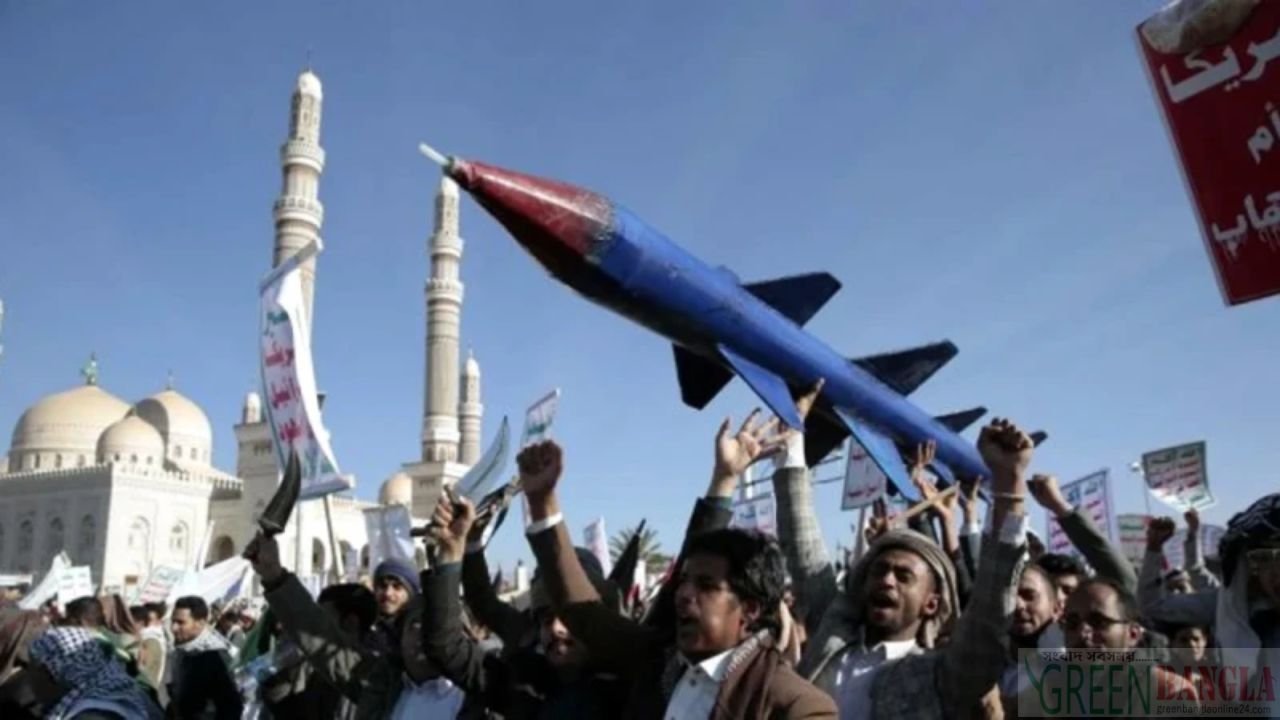
Following the Gaza war, the Houthis began launching missile and drone attacks on Israel in October 2023. Initially, these attacks were not very effective. Most of the missiles were intercepted by defense systems. However, in mid-2024, the situation changed. A drone attack on a residential building in Tel Aviv caused casualties. This raised new concerns about the Houthis’ capabilities.
According to analysts, the Houthis’ attacks are not a major military threat to Israel, but rather an effective way to exert strategic pressure. However, the biggest threat arises when the group targets shipping in the Red Sea. This route is crucial for international trade.
From November 2023 to early 2025, the Houthis have carried out nearly 200 attacks on ships sailing in the Red Sea. More than 30 ships have been damaged and at least one has been hijacked. As a result, shipping through the Bab al-Mandeb and Suez Canals has been reduced by almost half, putting a major strain on global trade.
In this situation, if Iran simultaneously closes the Strait of Hormuz and the Houthis block the Red Sea route, the global economy could suffer a serious blow. Because a large part of the world’s energy and goods are transported through these two routes.
Meanwhile, diplomatic efforts have also been intensified to defuse regional tensions. A meeting of the foreign ministers of Pakistan, Saudi Arabia, Turkey and Egypt is being held in Islamabad at the initiative of Pakistani Foreign Minister Ishaq Dar. The meeting is scheduled to be held in Islamabad today, Sunday (March 29). The Egyptian foreign minister has already arrived in Pakistan to attend the meeting. Its aim is to restore ceasefire and regional stability. Pakistani Prime Minister Shahbaz Sharif is trying to mediate between the US and Iran. Iranian President Masoud Pezishkian has stressed the need for ‘confidence building’ to pave the way for talks. He stressed this in an hour-long phone call with Pakistani Prime Minister Shahbaz Sharif. In response, Prime Minister Shahbaz Sharif also thanked the Iranian president. He assured that Pakistan will continue its constructive role in restoring regional peace and stability.
On the other hand, a new dimension has been added to the battlefield in terms of technology. It has been alleged that an improved version of the Shahed drone has been supplied to Iran from Russia. European officials believe that these drones are being transported by truck through Azerbaijan under the guise of humanitarian aid. This could create new challenges for the defense of the US and its allies in the Middle East. However, Kremlin spokesman Dmitry Peskov dismissed the report as “false.” White House spokeswoman Olivia Wells said, “Whatever other countries supply to Iran will not affect the success of our operation.”
At the same time, the conflict is spreading on various fronts. Direct clashes between Hezbollah and Israeli forces in Lebanon are increasing. Drone strikes in Kuwait have damaged critical infrastructure. In addition, US bases in the Gulf region are also at risk of attack.
Israeli forces are currently trying to penetrate deeper into Lebanese territory. In some areas, they have advanced as much as 7 kilometers (4.3 miles) from the border. Last Friday, an anti-tank missile hit an Israeli soldier and seriously wounded another during fighting in southern Lebanon. In another incident, a rocket attack on soldiers in southern Lebanon early Saturday left one Israeli soldier seriously injured and six others moderately injured.
Meanwhile, a drone strike at Kuwait International Airport caused “extensive damage” to its radar system. The country’s state news agency KNA (KUNA) said the airport was “hit by several drone strikes.” However, the Civil Aviation Authority confirmed that there were no casualties. The Israeli military claimed that a missile was fired from Yemen after Iran-backed Houthi rebels threatened to join the war.
Meanwhile, the Israeli military said it was striking “various government targets” in the Iranian capital Tehran. The strikes took place early yesterday. An AFP journalist in Tehran said he heard about 10 loud explosions in the capital during the Israeli strikes. He also saw plumes of black smoke in the sky. US President Donald Trump said on Friday that the US still has “3,554” targets to strike in Iran. “They will be done very quickly,” Trump said.
A US official said that 12 US troops were injured in an Iranian missile attack on the Prince Sultan Air Base in Saudi Arabia. At least one military aircraft at the base was damaged in the attack. Two of the wounded soldiers are in critical condition. At least 303 US troops have been injured in attacks since the start of the Middle East war.
A deal has been reached to allow Thai oil tankers to safely pass through Iran’s Strait of Hormuz. Thai Prime Minister Anutin Charnvirakul said the deal would ease concerns about fuel imports.
US President Donald Trump’s special envoy Steve Witkoff is optimistic about a meeting with Iran to end the Middle East war. He said at an event in Miami, Florida, on Friday that the meeting could take place this week.
Iranian Foreign Minister Abbas Araghchi has strongly condemned Israel’s attack on Iran’s nuclear facilities. He warned that Israel would pay a “heavy price” for this “crime.” Araghchi responded on social media on Friday.
US Secretary of State Marco Rubio said the Iran war would be over in a matter of weeks. He said the US could achieve its goals in Iran without ground forces. The operation would be over in a matter of weeks, not months.
US Vice President JD Vance and Israeli Prime Minister Benjamin Netanyahu had a heated telephone conversation this week. The US media outlet Axios reported that the two argued over the Israeli prime minister’s “overly optimistic” stance on the war situation.
Meanwhile, Iranian Foreign Minister Abbas Araghchi and Russian Foreign Minister Sergei Lavrov held talks. The Russian Foreign Ministry said in a statement that they had discussed Friday to find a possible diplomatic solution to the Iran war.
The statement published on the ministry’s website said that the two ministers discussed in detail the most complex military-political crisis in the Middle East, which was created as a result of the unprovoked US-Israeli aggression against Iran.
On February 28, the US and Israel launched a joint attack on Iran. Then, Iran also attacked US bases in the Middle East, which triggered the war. Both Iran and Russia are under various US sanctions. It is also known that Iran is receiving support from Russia in this ongoing war.
Russia and Iran have a strategic partnership agreement. It includes political, economic, military and energy cooperation, but not defense cooperation.
The active participation of the Houthis has emerged as a key changer in this multi-faceted conflict surrounding Iran. Their aggressive posture, especially on the sea routes, is creating new risks for world trade. If the Strait of Hormuz and the Red Sea route are disrupted simultaneously, it could create a major crisis not only for the Middle East but also for the global economy.