
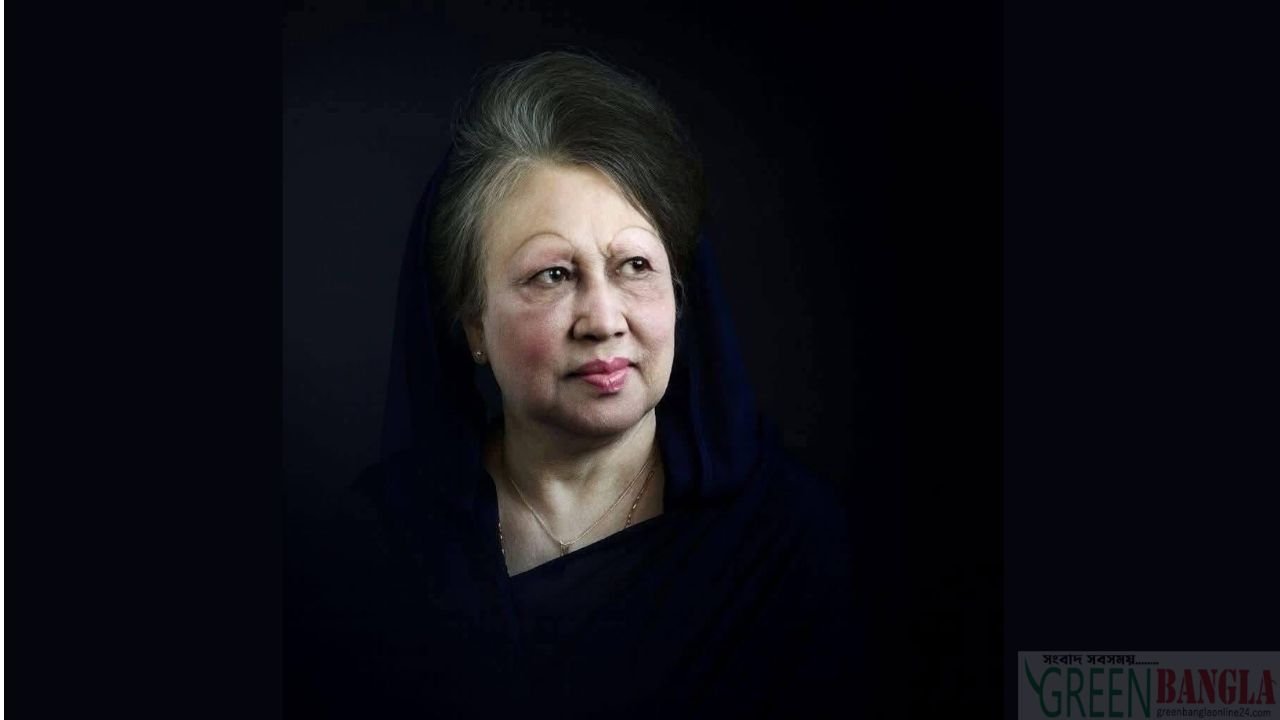
End of a Chapter
A star fell in the sky of Bangladeshi politics today. Ending all speculations and a long struggle, three-time former Prime Minister and Chairperson of the Bangladesh Nationalist Party (BNP) Begum Khaleda Zia has left for an unexpected country. She breathed her last (Inna Lillahi wa Inna Ilaihi Rajiun) while undergoing treatment at the Coronary Care Unit (CCU) of Evercare Hospital in the capital today (December 30). She was 80 years old at the time of her death.
BNP Media Cell member Atiqur Rahman Rumon confirmed this information to journalists. In addition, news of Begum Zia’s death has been published on all the party’s pages on Facebook. Her departure has brought a long and colorful chapter to a close in Bangladeshi politics. The country’s first female Prime Minister had been suffering from various physical ailments including liver cirrhosis, kidney complications, diabetes and heart disease for a long time.
She was admitted to the hospital late on November 23 after her physical condition deteriorated. Today she passed away, defying the best efforts of doctors and the prayers of millions. The once shy housewife became an uncompromising leader of the anti-dictatorship movement in the need of the hour. Taking charge of the party after the death of her husband, martyred President Ziaur Rahman, leading the mass uprising of the 1990s, confronting the 1/11 conspiracy and enduring unspeakable torture during the last 16 years of fascist rule – Begum Khaleda Zia’s life is an epic of sacrifice. Born in Dinajpur in 1945, Khaleda Khanam Putul was naturally quiet, shy and averse to publicity. After marrying Ziaur Rahman, a young officer in the Pakistan Army, her life revolved around her husband, family and children. But the great liberation war of 1971 changed the course of her life. While her husband Ziaur Rahman was serving as a sector commander in the battlefield, Begum Zia, her two sons Tarique Rahman and Arafat Rahman Koko were imprisoned by the Pakistani occupation forces in Dhaka.
She spent those 9 months of the liberation war in extreme uncertainty and mental torture.
Every moment was spent in fear of death. She was released after the country became independent on December 16. After independence, when Ziaur Rahman assumed the duties of the army chief and later the president, Begum Zia still kept herself away from the glitter of politics. She was an ideal mother and wife. Even at the center of power, she led a simple life, which later made her acceptable to the common people.
The tragic death of President Ziaur Rahman in a failed military coup at the Chittagong Circuit House on May 30, 1981, extinguished all the light in Begum Zia’s life. After the martyrdom of Ziaur Rahman, when the BNP was in existential crisis, with divisions, conspiracies and leadership conflicts at their peak, she left home and took to the streets at the request of senior party leaders and workers. She became a primary member of the BNP on January 3, 1982 and took over the party’s responsibilities in 1983. Her arrival in politics was like a comet. Transforming the grief of losing her husband into strength, she wandered from Teknaf to Tentulia. The woman who was once shy to speak in public, became the voice of millions of people.
She stood as a lone bulwark against the military rule of General Ershad. In 1986, when many other parties decided to go to the polls under Ershad, Begum Zia declared in an unequivocal voice, “No election can be fair under Ershad. Going to this election means legitimizing autocracy.” This one decision of hers established her as an ‘uncompromising leader’ to the people. She fought on the streets for 9 long years. While leading processions, she faced police baton charges, tear gas shells and repeated house arrests, but she never bowed her head on a question of policy. Her stubborn stance hastened the fall of the autocracy Ershad in 1990. Under her leadership, the demand for a non-partisan caretaker government in the country as outlined by the seven-party alliance was established. The BNP won a single majority in the most fair election in Bangladesh’s history, held on 27 February 1991. Begum Khaleda Zia was sworn in as the first female Prime Minister in the history of Bangladesh and the second in the Muslim world. After forming the government, she brought about a radical change in the political structure of the country. She returned the country to a parliamentary democracy by changing the presidential system of government, which played a significant role in institutionalizing democracy.
During her reign (1991–1996 and 2001–2006), Bangladesh witnessed revolutionary changes in the socio-economic field. She believed that “education is the backbone of the nation and women are the key to development.” In light of this philosophy, she introduced free education and stipends for girls up to class 12, as a result of which educated women can be seen in every household in Bangladesh today. It was during her reign that the construction of the Jamuna Multipurpose Bridge was started and completed, which connected the entire country to North Bengal and turned the wheels of the economy around.
In addition, she broke the monopoly of the telecommunications sector and brought mobile phones within the reach of the common man. The revolution of road construction through LGED for environmental protection, social afforestation and rural infrastructure development was achieved during her rule. She brought about a boost in the country’s revenue by introducing VAT or Value Added Tax.
A dark shadow fell on politics when a state of emergency was declared in the country on January 11, 2007. The military-backed caretaker government became desperate to implement the depoliticization process or the ‘minus two formula’. At that time, Begum Zia was put under intense pressure to leave the country. It was said that her sons would be released if she went to Saudi Arabia. But even after everything was ready at the airport, she refused to leave the country. At that time, the international media Reuters wrote, quoting an intelligence officer and her close aide, “Yes, the situation has changed and she will not go.”
If she had accepted exile, the political reforms, elections and power-sharing process of the caretaker government of 2007-2008 might have been different. But instead, she continued her politics from home despite facing imprisonment and lawsuits. This courageous and patriotic stance thwarted the conspirators’ blueprint. She was arrested and kept in sub-jail on false charges, but she did not budge an inch from her commitment to the country’s soil.
The continuous mental and physical torture inflicted on Begum Khaleda Zia for 16 long years since the Awami League came to power in 2009 is unprecedented in the history of independent Bangladesh. Such ruthless use of the state machinery against the head of a political party and a three-time former Prime Minister is rare in world politics.
The first major blow of torture came in 2010. She was evicted from her house on Mainul Road in Dhaka Cantonment, where she had lived for 40 years, which is related to the memory of her husband, martyred President Ziaur Rahman. She was evicted shamefully on the pretext of a court verdict. That day, the people of the country saw her leaving her house crying, clutching the memory of her husband. This incident was the first step in the psychological torture on him, the purpose of which was to break him mentally.
When she called for the ‘Democracy March’ on December 29, 2013, the government blocked her by parking five huge trucks filled with sand and bricks in front of her Gulshan residence. When she tried to leave through the gate, pepper spray was thrown directly at her. Such behavior towards a former prime minister shows great shamelessness.
During the ongoing blockade in 2015, she was locked up in her Gulshan political office for 93 days. Electricity, internet and food supplies were cut off. It was during this blockade that she received the news of the death of her younger son Arafat Rahman Koko. Koko died in exile in Malaysia, a victim of political vendetta. When her son’s body was brought home and placed in front of her Gulshan office, a heartbreaking scene unfolded.
She broke down in tears upon seeing the dead face of her son, who had been in exile for so long. As a mother, she did not get the opportunity to be by her sick son’s bedside. She had to mourn the loss of her child amidst locked office gates, police barricades and sand trucks. While millions of people gathered at Coco’s funeral, Begum Zia, as a mother, was under house arrest. The government also used the tragic incident as a tool to mentally devastate her.
More than 37 political vendetta cases were filed against her. On 8 February 2018, she was sentenced to 5 years in prison in the Zia Orphanage Trust case and kept in solitary confinement in the abandoned Central Jail on Nazimuddin Road in Old Dhaka. Her physical condition deteriorated rapidly due to the damp environment. Severe arthritis pain caused her hands and feet to bend and her diabetes became uncontrolled. She was later shifted to Bangabandhu Sheikh Mujib Medical University (BSMMU), but her family alleged that she was not given proper treatment there. Although doctors repeatedly advised her to seek better treatment abroad, the then government did not give her that opportunity due to political vendetta. While in prison, due to lack of proper treatment, her liver cirrhosis, kidney and heart disease went out of control. Although the medical board recommended sending her abroad for better treatment, she was not allowed due to the political vendetta of the then head of government. It was repeatedly said, “She cannot go abroad without legal process.” During the Corona pandemic, she was allowed to stay at home from prison conditionally, but it was practically house arrest. She was bound by various conditions such as not being able to do politics, not being able to go abroad, etc. But despite all this, she did not give up. She did not compromise with any unfair proposal of the government. It was her silent patience that earned her the title of ‘Mother of Democracy’.
Sheikh Hasina and her government did not stop at just filing false cases or giving her imprisonment; they carried out a horrific campaign of character assassination against Begum Khaleda Zia. Sheikh Hasina, violating all the limits of political etiquette, made extremely hateful, inhuman and ugly remarks against the former Prime Minister at various times. Over the years, the state machinery has been used to stigmatize Begum Zia in the public mind as a ‘thief of orphans’ money’. Sheikh Hasina even made ugly jokes about Begum Zia’s personal life, her grooming and eating habits in Parliament and public meetings. When Begum Zia was seriously ill and fighting for her life in the hospital, Sheikh Hasina publicly said that Begum Zia was faking illness or putting on a “show”. She even sarcastically said, “Khaleda Zia is old, now she will be sick and miserable, what will we do if she dies?” But Begum Zia never retaliated against these ugly remarks, maintaining her natural nobility and silence.
On August 5, 2024, when the government of 16-year-old dictator Sheikh Hasina collapsed in a violent mass uprising by students and the public and she fled the country, Begum Khaleda Zia was receiving treatment in a bed at Evercare Hospital. The day after Hasina fled, on August 6, President Md. Shahabuddin ordered her unconditional release. This ended her long 6-year prison sentence and virtual house arrest. In a bid to slowly end the leader who was being tried to turn from the ‘Mother of Democracy’ into a ‘Convicted Prisoner’, a cruel twist of fate released her in the guise of a hero and forced her tormentor to flee the country.
On hearing the news of Hasina’s escape and the collapse of the Awami League, she thanked God Almighty, but there was no triumphant exultation or mentality to suppress her opponents. Rather, after the victory, she showed extraordinary statesman-like generosity. The speech she gave virtually from the hospital at the historic BNP rally in Nayapaltan on August 7 after her release will be written in golden letters in the pages of history.
Despite being a victim of torture and injustice for a long time, she said, “Not destruction, not revenge, let’s build a society of love and peace. This victory has brought new possibilities for us. We have to build a prosperous Bangladesh from the ruins of unprecedented corruption and democracy for a long time.” Her statement proves that she was not just in politics for power, but was a great leader who was above revenge.
Begum Khaleda Zia was not only the leader of Bangladesh, she was also an influential figure in the international arena. In recognition of her leadership and struggle, the world media and international organizations have honored her at various times. The influential US-based magazine Forbes has listed her as one of the world’s most powerful women several times, a rare honor for a Bangladeshi leader. As one of the first female prime ministers in the Muslim world, she was also highly respected by leaders of the OIC and Commonwealth countries.
For her political foresight and uncompromising attitude, international media outlets Time Magazine and The New York Times have described her as an indispensable force in Bangladesh’s democracy. After her imprisonment in 2018, The New York Times noted in a report, “Khaleda Zia is the matriarch of the opposition.”
In addition, international human rights organizations have always been vocal about the persecution against her. During the Awami League period, Amnesty International and Human Rights Watch have noted in their various reports that Begum Khaleda Zia was a victim of political vendetta and that she did not receive a fair trial. Lord Alexander Carlyle, a British lawyer and head of his international legal team, has described Begum Zia’s cases as “baseless”.
Begum Khaleda Zia is an uncompromising symbol of Bangladesh’s sovereignty and democracy. She could have lived a safe and luxurious life as the wife of the army chief, but she chose the dust of the highways. She could have been at the center of power as the wife of the president, but she chose the struggle against tyranny. She could have compromised and lived a luxurious life abroad, but she chose the dark depths of a prison cell.
Although she is gone today, every chapter of her 54-year history shines. The people of the country mourn for the country for which she lost her husband, for which she saw her child crippled, for which she held the lifeless body of another child in her arms. Begum Zia’s body may have been weakened by torture, imprisonment and lies, but her spine was not broken. Her ideals, patriotism and sacrifice will remain immortal. Begum Khaleda Zia is a pole star in the history of democracy in Bangladesh, whose light will never be extinguished.


